DISC should make your life easier; not harder. Learn how.
 In my 20 years of experience as a facilitator and instructional designer, the most difficult part of the job is: how to get participants to apply what they’ve learned. Do you agree?
The good news is, at Extended DISC, our two main goals are to support you and help you to help your clients. You wear many hats, in your role as facilitators, coaches, instructional designers. The last thing you need to is spend too much time on one ‘more thing’.
Have you ever felt you’re recreating the wheel over and over again? Were there ever times you needed to apply DISC to leadership training or team development? Did you need to adapt to deliver DISC training virtually? The 4 Steps to Effective Interactions are designed to provide you with a template for all things DISC.

Don’t stop at awareness.
Think about the 4 steps like an antibiotic. You are always told to complete the full prescription; don’t stop taking it. Well, don’t short change your participants and try paring down the steps. (I know it happens because I’ve worked at an organization who would skip any aspects of application practice to save time). The full application is the opportunity for your participants to practice and learn. This is where “a-ha” moments occur.
The power of DISC is consistent application. Simplicity of the tool and positive results aids application; often resulting in learned behaviors. Providing ample time to practice in the DISC session creates a jump start to your return on investment. After all, aren’t your employees worth the investment?
You can’t run until you’ve learned how to walk
There is an intentional methodology to the 4 steps to effective interactions. As a child, you didn’t learn to run before you learned to walk, did you? No, first you learned to crawl, then cruise, then walk, then run. You were building your muscles to give yourself confidence and strength in your abilities.
The 4 steps to effective interactions are built with that same thought process. They are designed to give you confidence and strength in understanding and applying DISC. These are the building blocks to your workshops being effective and your participants leaving and having more effective interactions.
So…what are the 4 steps?
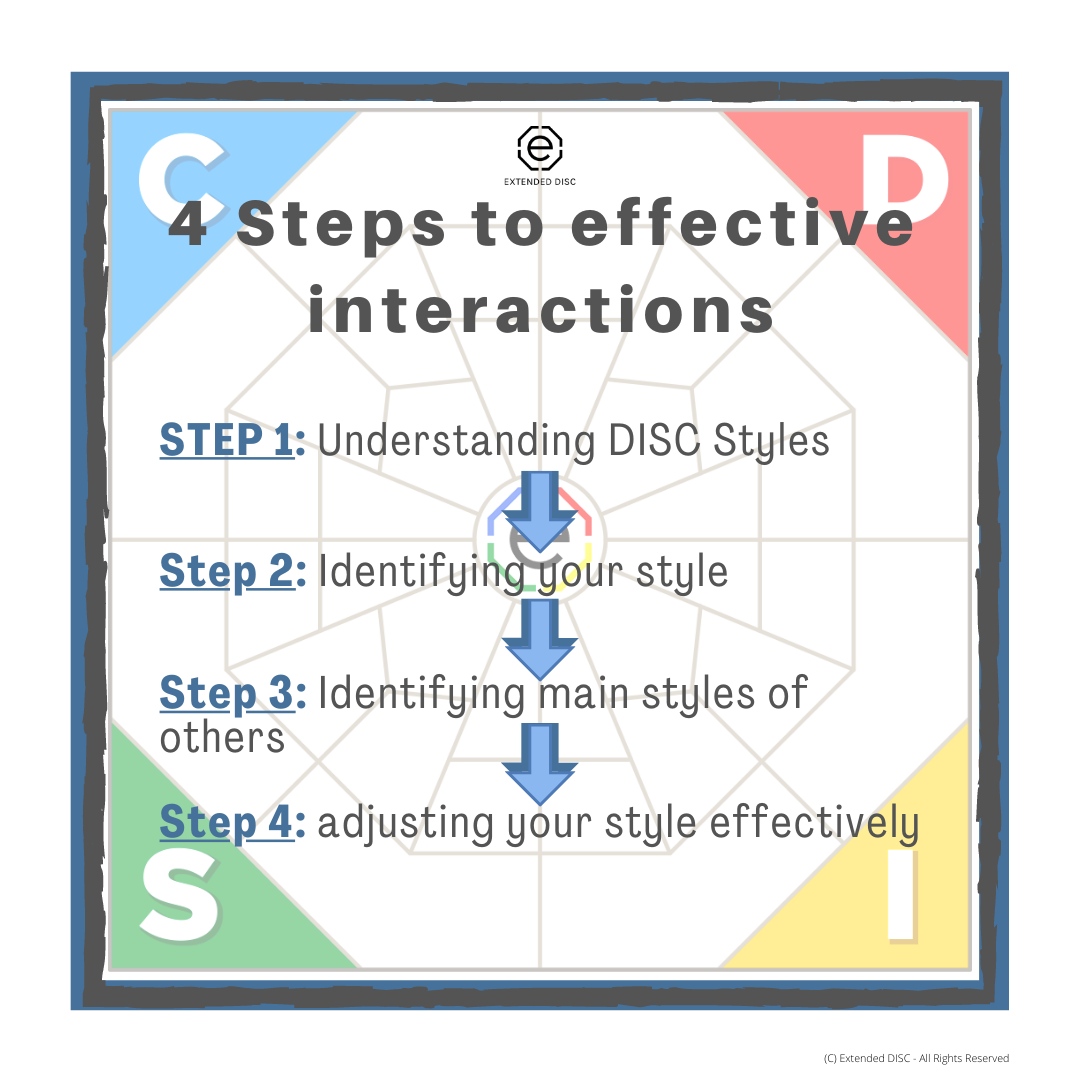
Step 1 is learning how people are similar and different. You use the 4 quadrant DISC model to help you explain the similarities and differences between the styles. Next, Step 2 is understanding your own individual DISC style and how others may perceive that style. Step 3 is identifying the style of others to better understand them and also to know how best to navigate to step 4. Finally, Step 4 is making temporary, brief adjustments to your style to help you improve the interaction with another person and to ultimately, help you achieve your goals and success.
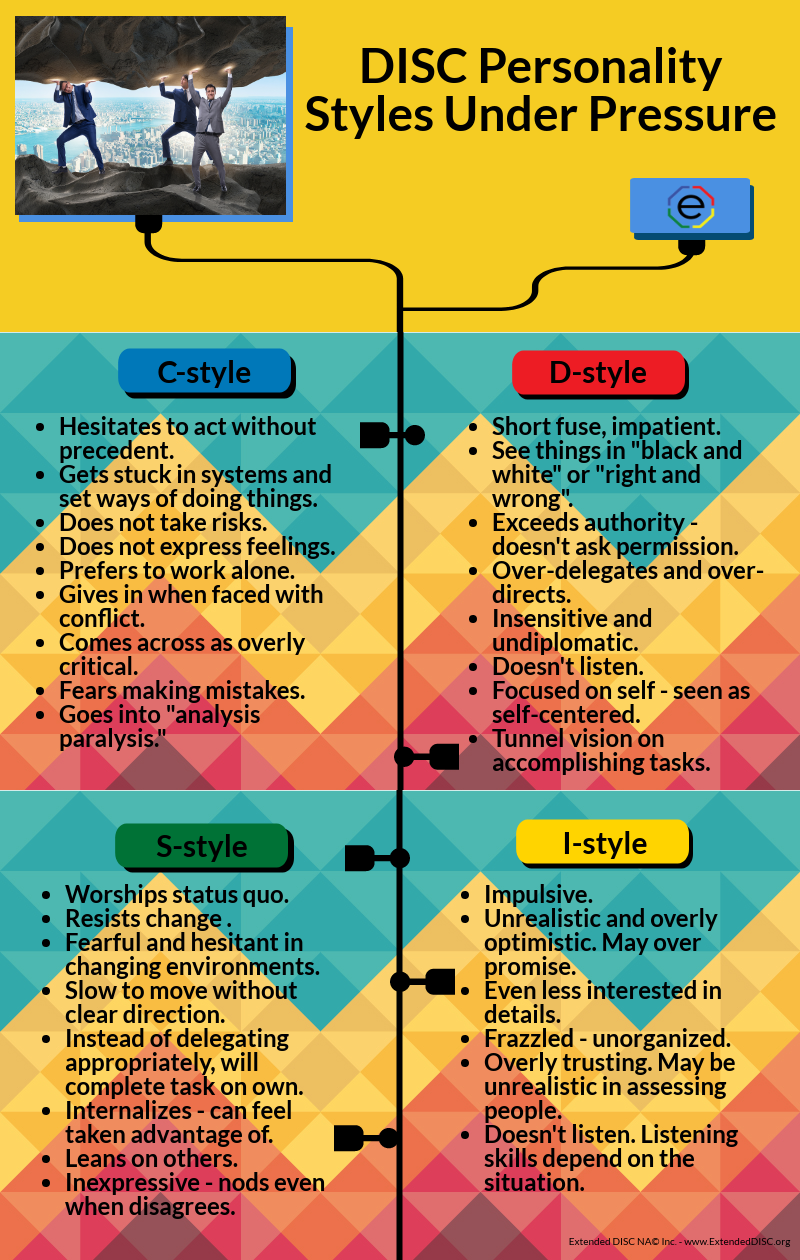
Sounds easy, right? You already know DISC is easy to use and understand. The difficulty is consistency. Life happens. Your participants leave your workshop and return to their daily jobs. Stress, pressure, and fatigue may enter the picture. These strong emotions drain your energy; making it difficult to remember and apply what you learned in training. That’s why practical application, from the start ,is so important.
How can I practice?
You have a plethora of resources available at Extended DISC. Many exercises can be applied during various steps within a workshop or with specific types of workshops; i.e leadership or team development training.
However, two of my favorite exercises incorporate all 4 steps and are universal; meaning they can be used in any type of workshop. The exercises are called: How Do I Relate? and My Communication Strategy. The exercises are designed to walk participants through all 4 steps of the process in an easy to do manner. They show the simplicity of the tool and the small amount of time it takes to apply.
The more opportunities you can provide to your participants in applying DISC theory into their real world lives and jobs; the more effective they will be when leaving your workshop. Remember, consistent application is the power of the tool.
Reach out to us to learn more ways you can incorporate DISC into real world application.


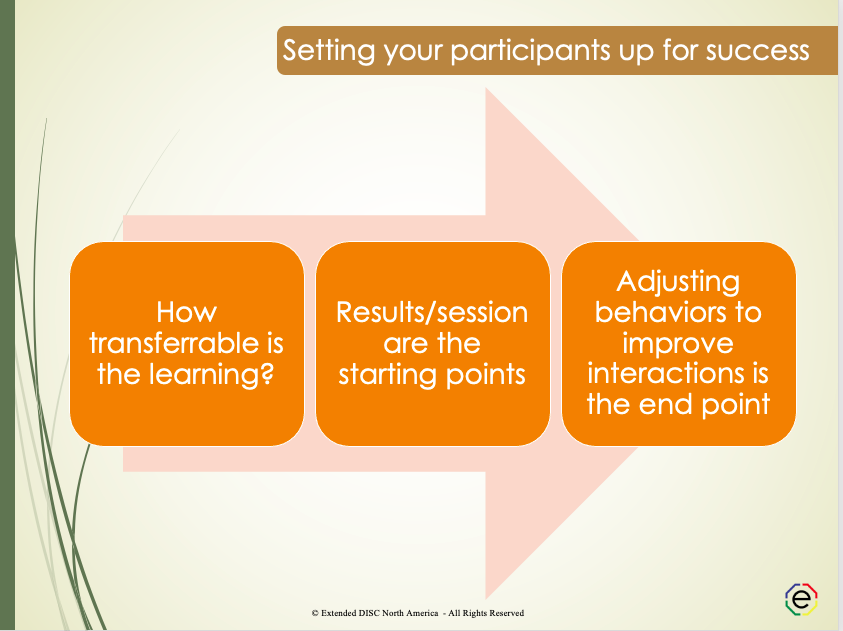 A comprehensive DISC training puts the DISC session squarely at the starting point. The end point of a successful training is the transfer of learning into the job role and life.
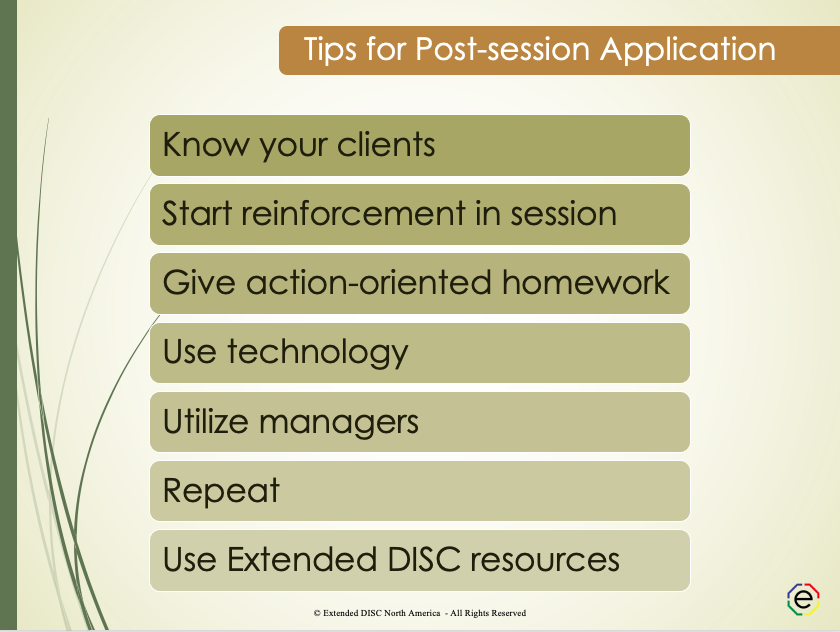
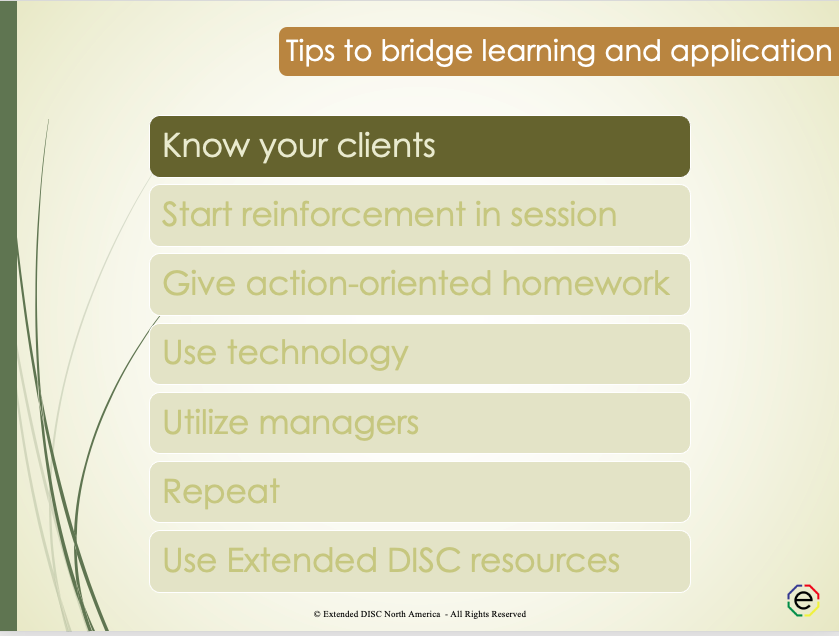 If you have the opportunity to follow-up one-on-one or in smaller groups, consider their DISC styles. What would be more motivating for them to continue practicing what they learned?
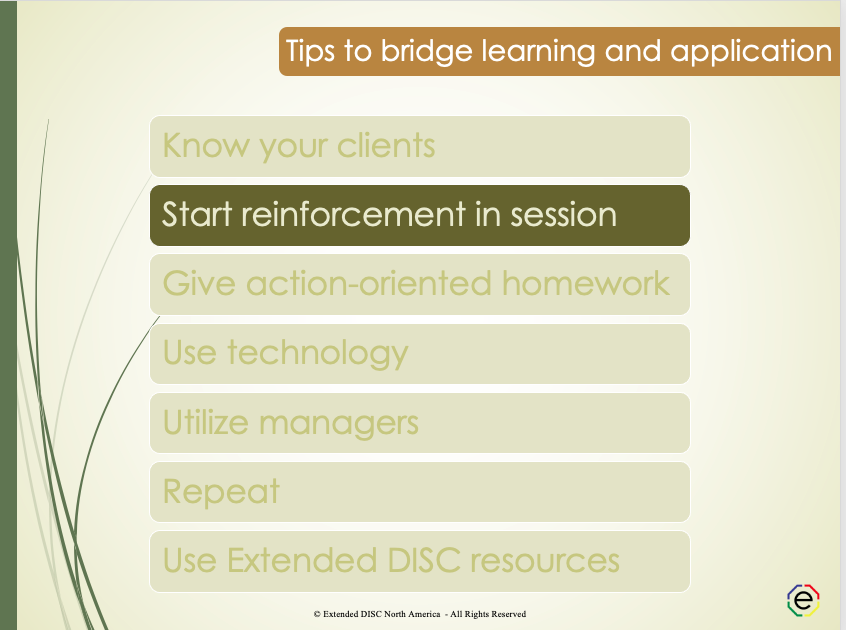 Starting their homework in session increases the likelihood of continuing it; especially when the effort generates success in practice. Different ideas include journaling their first day’s learning and successes, setting a reminder check-in on their phone, or matching up learners for a ‘phone a friend daily check-in’. The important thing is to commit to something before they leave your session.
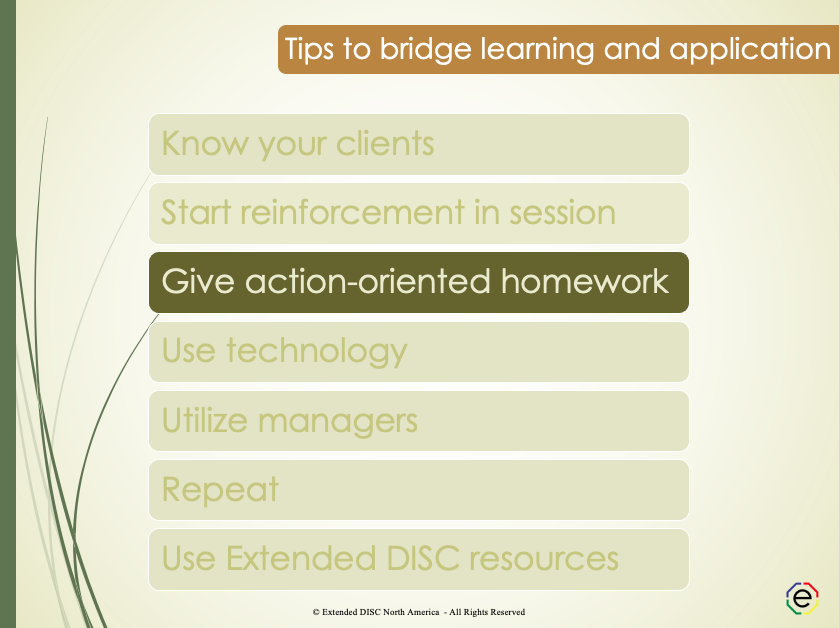
 Your social learners may respond well to a chat group. Others may find it fun to do an online quiz; prizes can make it more motivating!
 People recognize the value of DISC even more when their managers and leadership do. Managers can reinforce it daily by using the language of DISC. It may be as simple as asking their employees, ‘what was the DISC style of their client?’ or ‘what adjustments did you consciously make with your client? They can review DISC styles in a team meeting or build DISC style identification into their CRM.
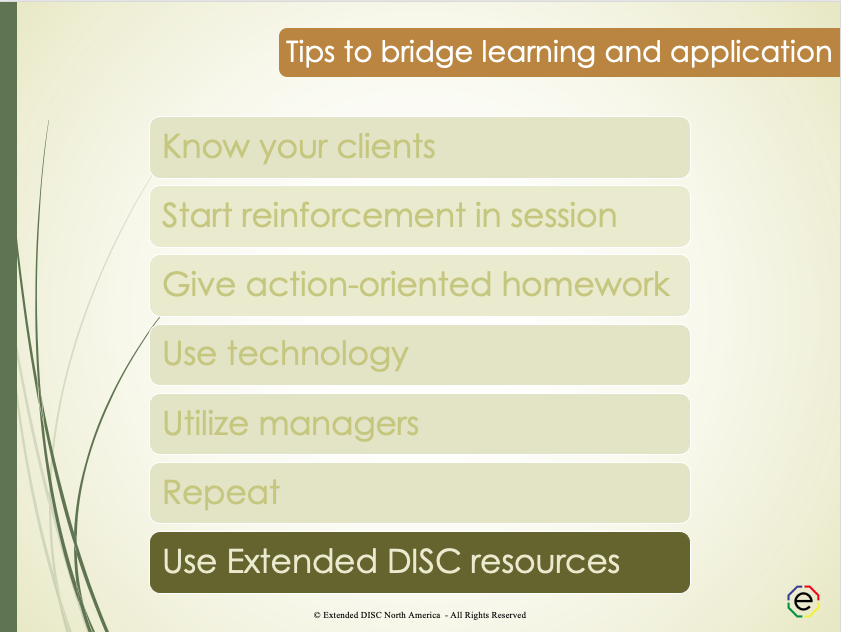
 Have learners redo or revisit worksheets, DISC report, and journals to reflect and make additional observations and adjustments. Repetition and practice lead to successful habits.